

What are risk practitioners focusing on in 2026? In our second annual Risk agenda, we gathered contributions from 50 of our members, risk leaders spanning 20+ sectors and 6 continents.
We asked them a simple question: what are you prioritising in 2026 to uplift risk management at your organisation? From emerging risk to risk appetite, in this blog we share some of the highlights from the report, and how our members are starting to tackle these objectives.
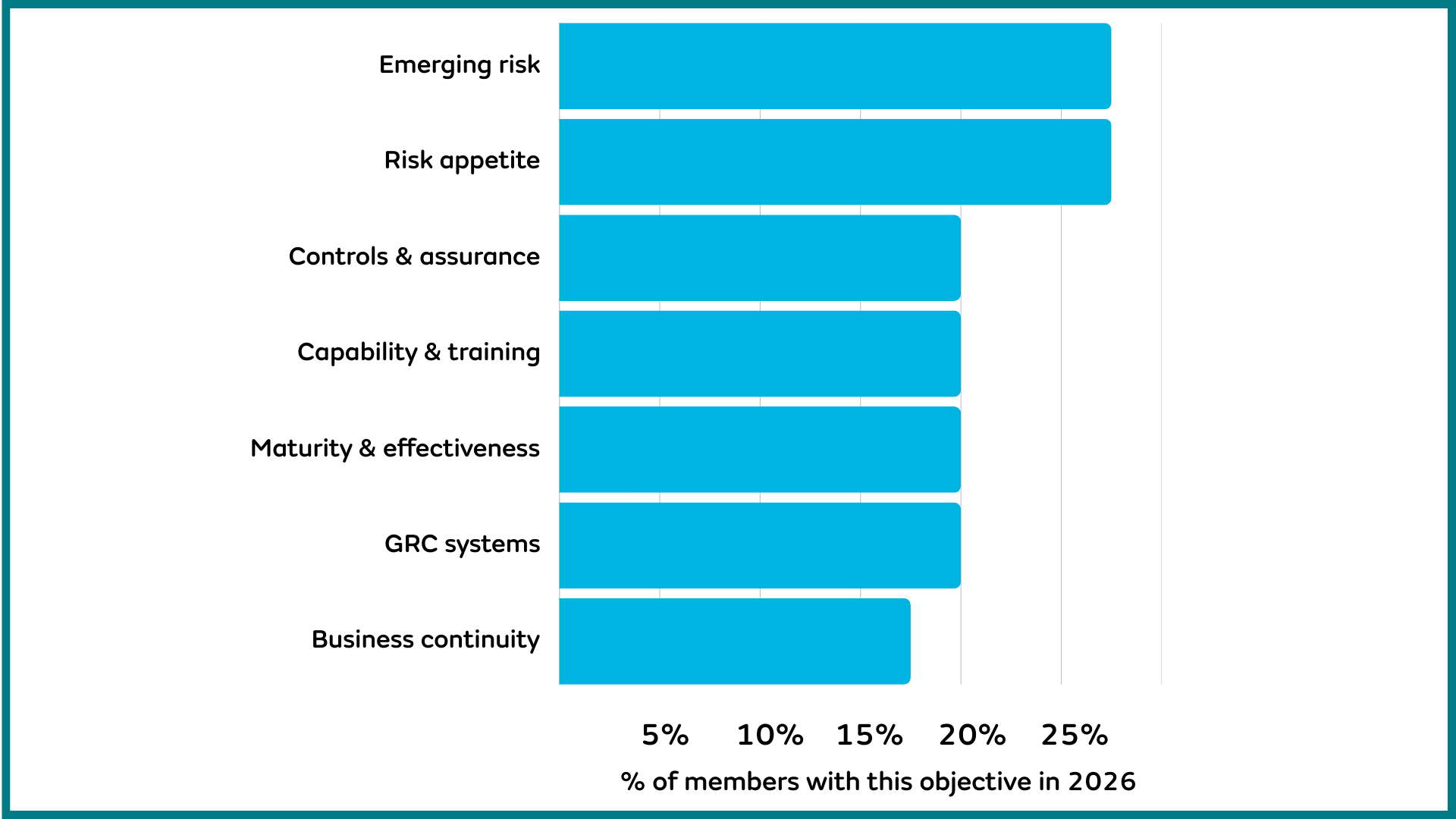
Emerging risk and risk appetite stand out as the leading risk management objectives for 2026, reflecting a growing ambition among our members to reimagine Risk as a strategic enabler. While these themes along with most others appeared on the list last year, the order of our top 7 has shifted, due to evolving focuses and the effect of common external influences.
The number of members working on emerging risk objectives nearly doubled in the past year, marking an evolution in how companies are tackling emerging risks.
Rather than treating horizon scanning as a separate task, organisations are making this a core part of their risk frameworks and strategic planning. This shift helps teams develop emerging risk indicators, ensuring that new strategies are built on measurable, forward-looking data rather than just hindsight. Organisations are also increasing investment in and adoption of horizon scanning tools to work towards this objective.
How we’re supporting our members with emerging risk objectivesRisk Leadership Network’s Horizon Scanner helps risk leaders in our network automate the summary and analysis of emerging risk data from hundreds of relevant sources. Developed with our members, we're now working with them to integrate the intelligence into their organisations with 4 key use cases:
|
-1.png?width=897&height=573&name=AI%20Horizon%20Scanner%20dashboard%20and%20pages%20(3)-1.png)
As in 2025, risk appetite ranks as one of the top objectives for practitioners into 2026.
More companies are using risk appetite to prioritise tasks and make better decisions. However, the focus is shifting: instead of appetite being a tool for executives only, leaders are now pushing that awareness down through the entire business.
This trend is a top priority for risk leaders today. A key part of this is making risk appetite statements practical rather than theoretical. The goal is to ensure these guidelines are just as meaningful to a frontline manager as they are to the CEO.
Member story: supporting CSL with risk appetite statementsWe supported member CSL with refreshing their risk appetite statements. They faced two main hurdles: monitoring the statements was taking up too many resources, and reporting the findings in an engaging way was difficult. To help them meet these goals, we provided tailored support in two stages:
|

While emerging risks and risk appetite are the big themes for 2026, the Risk agenda found that our network of risk leaders is also focusing on several other key objectives in 2026:
-
Better tech foundations: Implementing or improving GRC systems is still a major objective. Solid technology is seen as the enabler for AI and intelligence.
-
Upskilling the team: Capability remains front of mind, with many risk leaders believing that transforming the business starts with a skills uplift. This includes building skills not just for specialised risk teams, but for everyone across the organisation.
-
Building business resilience: Objectives range from creating practical Business Continuity Plans (BCPs) to enterprise aggregation and aligning Risk with strategic resilience frameworks.
In our Risk agenda report, we highlight innovative practices that are becoming integral to the future of risk management:
-
Risk interconnectivity – This is an increasingly hot topic amongst our members. Risk leaders are exploring how to leverage advanced technologies, including AI, to analyse and report risks in a more dynamic and interconnected way.
-
Capability uplift – While training is a recurring theme, there is a shift toward a more strategic, long-term view of risk capability. This is driven by ERM’s evolving role: moving from a compliance and audit function to a strategic advisor for the entire enterprise.
-
Leveraging AI – The role of AI in enterprise risk management is maturing, allowing early adopters to move away from traditional manual processes. Some members are already embedding AI into their risk analysis process and we expect this trend to accelerate in 2026.
This blog shares highlights from the Risk agenda 2026. Download the full report for more insights on how risk leaders are tackling the challenges outlined in this article and to benchmark your plan for 2026 against peers.
If you’d like to talk to us about the findings in the report, or if you have a specific objective in mind, please book an exploratory call to discuss what your focus areas are for the year ahead.
Share this

Emerging risk approaches: 5 key trends

What are the risk priorities of technology companies?