

We recently surveyed risk leaders at 84 companies to find out how they identify, analyse and report on emerging risks. One thing was clear from our findings: in a rapidly changing world, risk leaders are having to adapt their approaches to managing emerging risks.
In this blog, we explore the 5 key trends from our report, from the maturity of frameworks used to how emerging risk information is sourced.
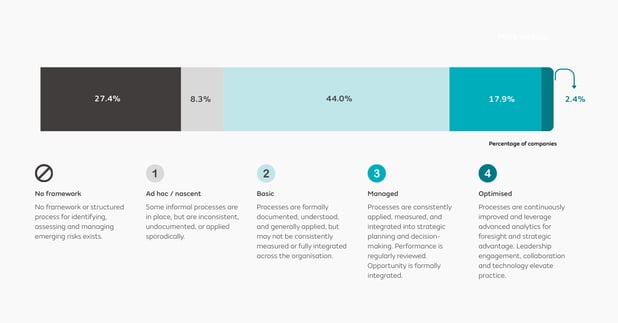
Our survey found that roughly 75% of organisations have some kind of framework in place to manage emerging risks, indicating a clear trend towards the adoption of formal processes for emerging risk management.
However, just 20% of organisations would define their framework as either ‘Managed’ or ‘Optimised’. More than half of the companies surveyed operate a ‘Basic’ or ‘Ad hoc’ framework with respect to emerging risks – meaning that while processes are documented, there is little consistency or integration within the wider business.
Although only a small minority of organisations (7%) use emerging risk signals or early warning systems, most companies monitor emerging risks on a periodic basis.
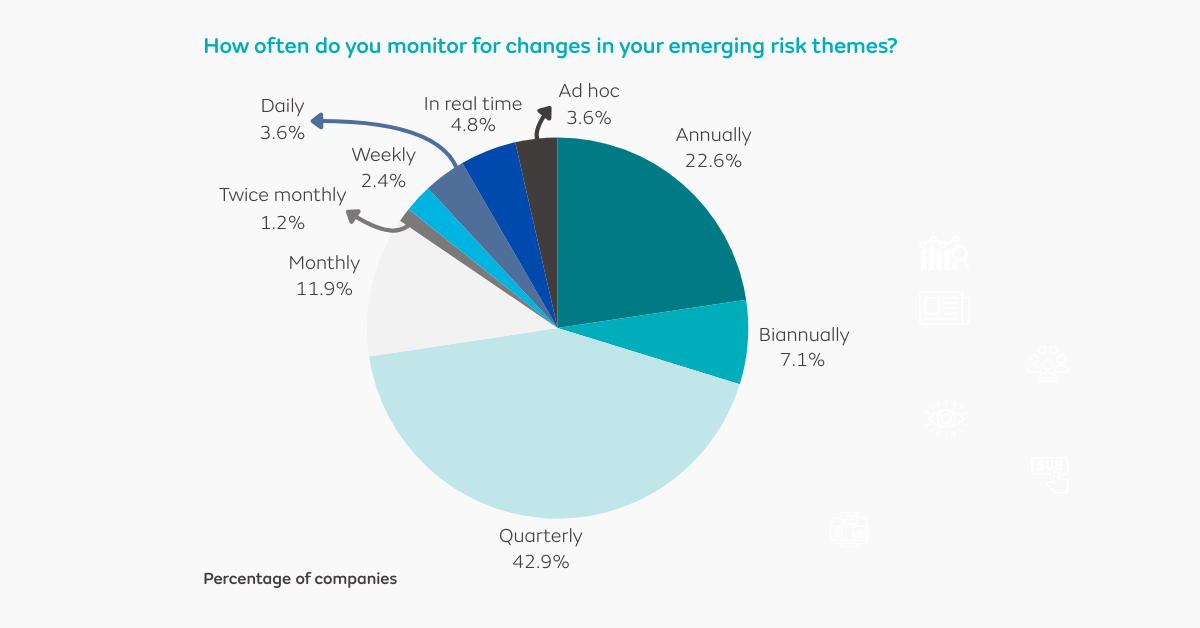
While there are many approaches, quarterly monitoring is by far the most common, with more than 40% of organisations choosing this approach. A third of organisations also report on emerging risks (either to the ARC or the board) once a quarter, showing a clear correlation between monitoring and reporting.
Organisations are relying on both external reports and internal workshops involving subject matter experts for gathering emerging risk information.
External risk and industry reports are the key sources of emerging risk data for 74 of the organisations surveyed, while 60 companies conduct some form of internal workshop with senior leaders, the business or both.
While traditional media reports remain a valued source of information for companies, the use of these has dropped since our survey last year. This fall, from 85% to 64%, suggests a loss of trust in these sources.
-1.png?width=897&height=573&name=AI%20Horizon%20Scanner%20dashboard%20and%20pages%20(3)-1.png)
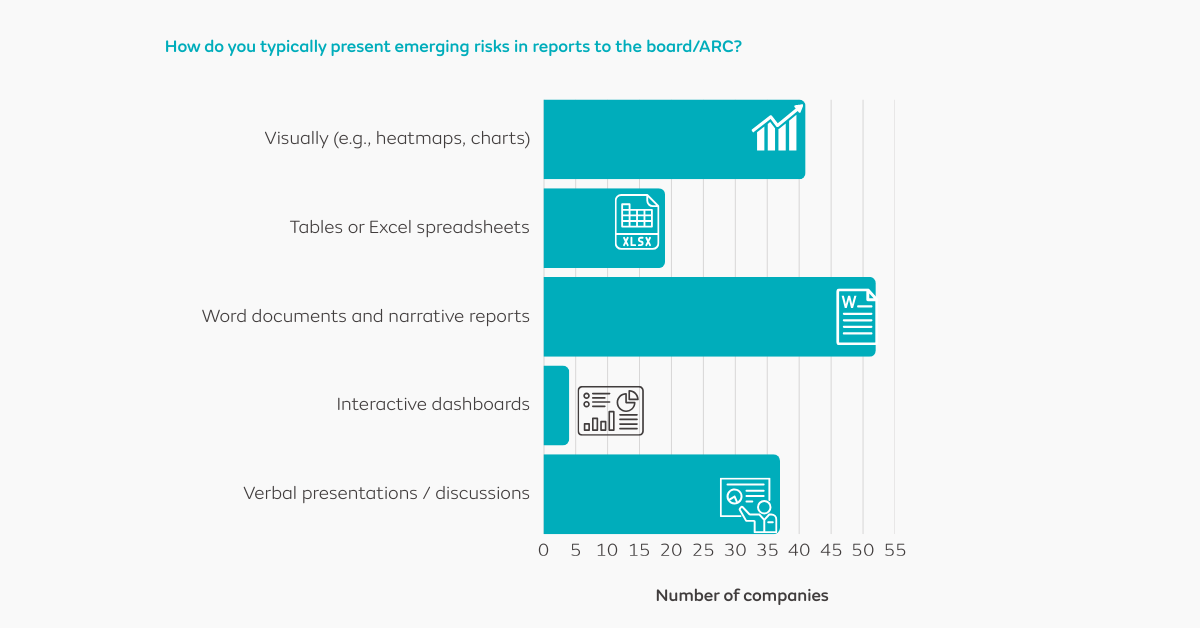
Risk teams at 73 companies say they include an up-to-date watchlist of emerging risks in their reports to the board, but just 8 companies analyse and/or present scenarios in their reports. There is much wider use of qualitative commentary than quantitative data included in reports.
This is further illustrated in the graph below, which shows the majority of companies use Word documents or narrative reports to present emerging risks.
Our survey found that 60% of organisations are moving towards including emerging risk insights in their strategic planning and decision-making processes, highlighting a growing recognition of Risk's impact on strategy. This is happening in a number of ways:
- Formally incorporating emerging risk discussions into regular strategy meetings, as a standing agenda item as opposed to an ad-hoc activity.
- Making the process of identifying and assessing emerging risks a collaborative effort involving various departments and senior leadership. It does not sit solely within the risk management function, but is actively discussed in the wider business.
- Aligning emerging risks with key business objectives to ensure that risk insights are relevant and actionable, rather than just a "watchlist" of potential threats.
While many risk leaders are thinking about how they can move from qualitative assessments of emerging risks towards more measurable quantitative methods, this remains an aspirational goal for most organisations.
We at Risk Leadership Network are facilitating a range of collaborations to support our members to make this aspiration a reality. From one-to-one tailored collaborations with peers to developing our AI Horizon Scanner, we’re working with members wishing to upgrade their frameworks and become more proactive around emerging risk.
If you’d like to find out how you can benefit from this support in advancing your approach to emerging risk, request an exploratory call, or explore membership here.
Share this

Case study: Using AI to create an emerging risk taxonomy for the metals and mining sector

Risk Leadership Network’s top risk management insights of 2025