8 ways risk leaders are transforming emerging risk intelligence into actions
As our Risk Agenda 2026 showed, emerging risk remains firmly at the top of risk leaders’ to do lists. To stay ahead, many are using AI to gather the most up-to-date emerging risk intelligence data. But gathering it is only part of the story; it’s vital that these insights are transformed into action.

Since launching our Horizon Scanner last year, we’ve worked closely with members to turn emerging risk insights into organisational action. In this blog, we explore 8 practical ways risk leaders are doing exactly that.
1. Strengthening governance and reporting
Members are increasingly using external intelligence tools, such as our Horizon Scanner, as a trusted source to bolster their research into emerging risks. Comprehensive resources such as this help members move beyond the surface.
This intelligence is frequently used to provide executive-level insights for internal risk committees. By creating greater awareness of risks that might otherwise be missed, organisations can reduce ‘blind-spot anxiety’ for boards and ensure seamless compliance with evolving disclosure requirements2. Advanced AI integration
To ensure these insights aren't "just another report," members are increasingly integrating our data directly into their organisational workflows, particularly by using tools such as our Horizon Scanner in conjunction with Large Language Models (LLMs) like ChatGPT, Co-Pilot, or Gemini.
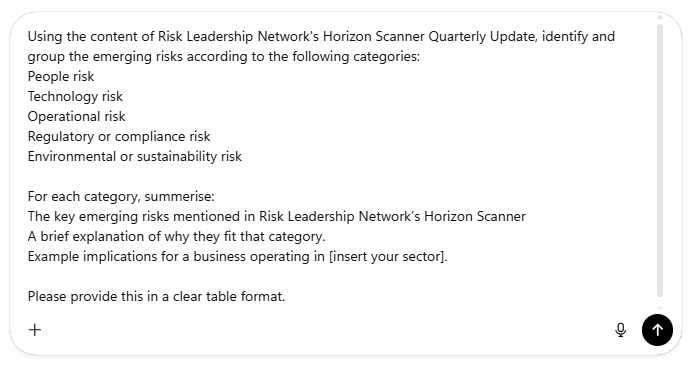
To facilitate this, we are collating examples of effective prompts that allow users to bridge the gap between global intelligence and their specific sector or business unit. By simply adapting these prompts and uploading comprehensive resources, such as the Quarterly Update, into an LLM, members can generate tailored, actionable takeaways in seconds.
Many risk leaders are feeding industry-relevant risks into private, self-hosted LLMs. This approach allows organisations to cross-reference and validate emerging risks against internal data streams without exposing sensitive corporate strategy to the public cloud.
Example LLM prompt - Risk categorisation
The purpose of this prompt is to map emerging risk intelligence from Risk Leadership Network's Horizon Scanner to specific business areas. These could be people risks, technology risks etc.
3. Facilitating workshops
We know that intelligence truly comes to life when it sparks conversation. Many members are now using comprehensive intelligence tools like our Horizon Scanner as a ‘threat map’ to facilitate emerging risk workshops across diverse business units, including Operations, HR, and Finance.
These sessions are instrumental in breaking down internal silos and fostering a more proactive risk culture. By engaging directly with this data, department heads are encouraged to take genuine ownership of future threats, gaining a clearer understanding of their specific preparedness to act should an emerging risk begin to materialise.
Download a sample
Explore a free non-member sample of the emerging risk intelligence shared in the first Quarterly Update from Risk Leadership Network's Horizon Scanner.
4. Digital twin and taxonomy mapping
We have worked with several members to create a 'digital twin' - essentially a bespoke taxonomy that mirrors their organisation’s enterprise risk framework, business categories, and sub-categories. By running intelligence from our Horizon Scanner against this twin, we can pinpoint which specific nodes of a member’s risk taxonomy are most sensitive to global trends, highlighting the themes that are gaining momentum each quarter.
The primary benefit of this process is precision. Rather than simply knowing that "AI is a risk," for example, you can identify exactly which part of your internal operational framework is most likely to be disrupted. This allows emerging risks to be mapped specifically to the business units they most closely relate to.
These taxonomies can also incorporate example scenario plans. This assists members in visualising the practical implications and potential outcomes should an emerging risk materialise, moving from abstract theory to actionable strategy.
Member case study
One of our members recently briefed their Risk Engagement Manager on the specific intelligence they needed to generate for their business. By using an LLM in conjunction with our Horizon Scanner, we worked with our member to produce a a risk taxonomy table.
This provided a clear breakdown of emerging risk scenarios, the business units most likely to be affected, and a cascade analysis of how these risks interconnect. The output also included a set of practical, targeted questions the member could take directly into internal workshops or board meetings to spark informed discussion.
Additional applications
Beyond the 4 core areas we have explored, members have shared a further 4 ways they are transforming the emerging risk insights into action:
- Acting as an outsourced analyst: Many organisations treat resources such as our Horizon Scanner as an extension of their team. The intelligence allows them to identify shifting trends in a timely manner without the overhead of a dedicated internal research unit.
- Driving strategic alignment: These insights are frequently shared by the risk team with strategy partners to spark high-level discussions on horizon scanning priorities and to provide a robust foundation for future scenario planning.
- Informing internal risk teams: Within risk functions, emerging risk reports can be use to generate discussions. This ensures that team sessions are informed by the latest external developments when setting risk priorities.
- Elevating executive dialogue: Risk leaders are increasingly using the intelligence found in tools such as our Quarterly Update to enhance their conversations with the board and executive committee. Whether used proactively or to provide a rapid response to board queries regarding global megatrends, this external perspective ensures leadership remains well-informed.
What's next?
From enhancing board-level reporting to integrating AI and digital twins, our members are consistently finding innovative ways to turn intelligence into action. By leveraging tools such as Risk Leadership Network’s Horizon Scanner, organisations are moving beyond broad monitoring to pinpoint the specific ‘so what’ for their business units and strategic priorities.
To support this journey, we are facilitating quarterly, SME-led deep dives into the emerging risk topics our members have flagged as most critical. These sessions are complemented by collaborative workshops where risk leaders exchange first-hand experiences, lessons learned, and practical approaches to risk management.
If you would like to learn more about how we’re working with risk leaders to leverage their AI-driven emerging risk intelligence, and how we can support your organisation, please request a meeting with our team to explore these insights in action.
Share this
Related posts you may be interested in

Three ways your peers are developing their risk function in light of emerging risks

Peer approach: incorporating emerging trends into risk reporting